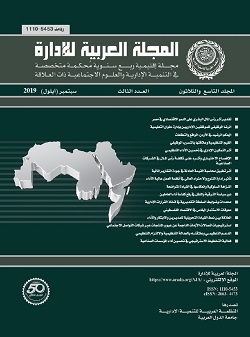
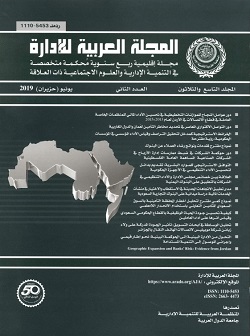
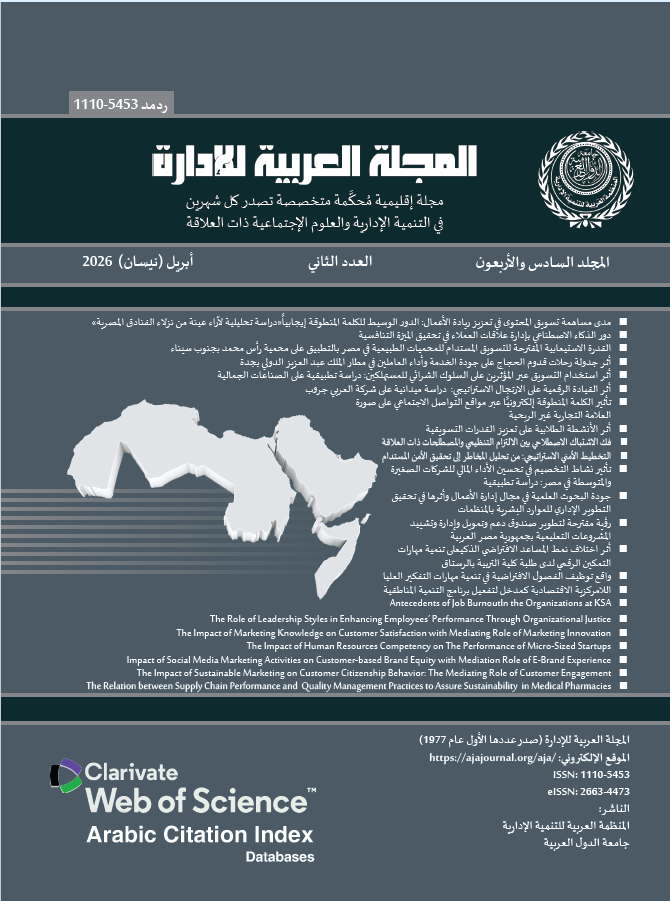
The Role of Leadership Styles in Enhancing Employees’ Performance through Organizational Justice: Evidence from Egyptian Higher Education Institutions

Article Sidebar
- leadership, Organizational justice, performance, Egyptian HEIs
Abstract
The purpose of this research is to empirically investigate the relationship between leadership styles and employees’ performance with mediating role of organizational justice in Egyptian higher education institutions (HEIs). The objectives of This research are: to investigate the relationship between leadership styles and Employees’ performance in Egyptian HEIs, to examine the relationship between leadership styles and organizational justice in Egyptian HEIs, to identify the relationship between organizational justice and Employees’ performance in Egyptian HEIs, to test the moderation role of university type in the relationship between leadership styles and Employees’ performance in Egyptian HEIs, to investigate the mediation role of organizational justice between leadership styles and Employees’ performance in Egyptian HEIs using structural equation modeling. The methodology will be based on quantitative analysis by using a questionnaire tool to gather required data and structural equation model analyses (SEM) using AMOS software version 26. The main conclusions drawn from this study are: the direct effect between Leadership Style and Employees Performance is statistically significant, the direct effect between Leadership Style and Organizational Justice is statistically significant, and the direct effect between Organizational Justice and Employees Performance is statistically significant. Finally, the study found that the results of the mediation effect indicate that there is a partial mediation effect of Organizational Justice between the relationship between Leadership Style and Employees' Performance.
Full text article
References
Addow, A. A. (2022). “The influence of leadership styles on employee performance in higher education: A case study from the university of Somalia (UNISO)”. EPRA International Journal of Environmental Economics, Commerce & Educational Management (ECEM), 9 (7), 13-19. http://eprajournals.net/index.php/ecem/article/view/629.
Ali, S. H.; Foreman, J.; Capasso, A; Jones, A. M.; Tozan, Y. & Diclemente, R. J. (2020). “Social media as a recruitment platform for a nationwide online survey of covid-19 knowledge, beliefs, and practices in the united states: methodology and feasibility analysis”, BMC Medical Research Methodology, 20, 1-11. https://bmcmedresmethodol.biomedcentral.com/articles/10.1186/s12874-020-01011-0.
Altun, M. & Tahir, R. (2020). “Motivational techniques in efl classrooms in the universities of Kurdistan”, International Journal of Social Sciences & Educational Studies, 7 (1), 88-94. http://eprints.tiu.edu.iq/249/.
Armstrong, M. & Baron, A. (2004). “Managing performance: Performance management in action”, cipd. https://books.google.com/books.
BasˇKarada, S.; Watson, J. & Cromarty, J. (2017). “Balancing transactional and transformational leadership”, International Journal of Organizational Analysis, Vol. 25, No. 3, pp. 506-515, doi: 10.1108/ijoa-02-2016-0978. https://www.emerald.com/insight/content.
Benson, T. H. & Martin, L. (2017). “The effect of inter-organizational justice perceptions on organizational citizenship behaviors in construction projects”, International Journal of Project Management, 35, 95-106. https://doi.org/10.1016/j.ijproman.2016.10.016.
Berger, J. B. (2013). Leadership: A concise conceptual overview. Massachusetts Community College Leadership Academy. Boston. https://scholarworks.umass.edu/cgi/viewcontent.cgi?article=1017&context=cie_faculty_pubs.
Budur, T. & Demir, A. (2019). “Leadership perceptions based on gender, experience and education”, International Journal of Social Sciences & Educational Studies, 6 (1), 142-154. http://eprints.tiu.edu.iq/5/.
Budur, T. & Poturak, M. (2021a). “Transformational leadership and its impact on customer satisfaction: Measuring mediating effects of organisational citizenship behaviours”, Middle East Journal of Management, 8 (1), 67-91. https://www.inderscienceonline.com/doi/abs/10.1504/MEJM.2021.111997.
Budur, T. (2018). The impact of al-ghazali’s virtues on organizational commitment and performance: A case study at private education institutions in Kurdistan region of iraq. icabep, Erbil, Iraq, 2, p21.https://www.tiu.edu.iq/business/icabep-archives/wpcontent/uploads/2018/02/21.pdf.
Creswell, John W. (2012). Planning, conducting, and evaluating quantitative and qualitative research, pearson publications. https://books.google.com/books.
Durmaz, O. (2017). “Investigation of the motivation parameters in health care establishments”, International Journal of Social Sciences & Educational Studies, 3 (4), 44-53. http://eprints.tiu.edu.iq/98/.
Fernet, C.; Trepanier, S. G.; Austin, S.; Gagne, M. & Forest, J. (2015). “Transformational leadership and optimal functioning at work: on the mediating role of employees’ perceived job characteristics and motivation”, Work & Stress, 29 (1): 11-31 https://www.tandfonline.com/doi/abs/10.1080/02678373.2014.1003998.
Hair, J. F.; Risher, J. J.; Sarstedt, M. & Ringle, C. M. (2019), “When to use and how to report the resultsof pls-sem”, European Business Review, Vol. 31, No. 1, pp. 2-24. https://www.emerald.com/insight/content/doi/10.1108/ebr-11-2018-0203
Hamid, D. & Durmaz, O. (2021). “Organizational culture impact on employee innovative behaviors in Kurdistan”, Black Sea Journal of Management and Marketing, 2 (1), 63-72. https://www.bsjmm.com/index.php/bsjmm/article/view/68.
Hao, Y.; Farooq, Q. & Zhang, Y. (2018). “Unattended social wants and corporate social responsibility of leading firms: Relationship of intrinsic motivation of volunteering in proposed welfare programs and employee attributes”, Corporate Social Responsibility and Environmental Management, Vol. 25, pp. 1029-1038. https://onlinelibrary.wiley.com/doi/abs/10.1002/csr.1681.
Ismail, A.; Mohamad, M.; Mohamed, H. & Zhen, K. (2010). Transformational and transactional leadership styles as a predictor of individual outcomes”, Theoretical & Applied Economics, 17 (6), 89-104. http://www.store.ectap.ro/articole/477.pdf.
Khajeh, E. (2018). “Impact of leadership styles on organizational performance”, Journal of Human Resources Management Research, Vol. 2018, pp. 1-10. https://ibimapublishing.com/uploads/articles/jhrmr/2018/687849/687849-1.pdf
Khan, I. U.; Khan, M. S. & Amin, R. U. (2020). “An investigation on the influence of organizational culture and justice towards employees’ performance”, Research Journal of Social Sciences and Economics Review, 1 (2), 37-45. https://www.rjsser.org.pk/ojs/index.php/rjsser/article/view/33.
Khan, S.; Fazili, A. I. & Bashir, I. (2021). “Counterfeit luxury consumption: A review and research agenda”, Journal of Consumer Behaviour, Vol. 20, No. 2, pp. 337-367. https://onlinelibrary.wiley.com/doi/abs/10.1002/cb.1868.
Khuong, M. N. & Hoang, T. Q. (2016). “The effects of organizational justice and ethical leadership on employee performance”, Journal of Economics, Business and Management, 4 (4), 327-333.https://doi.org/10.18178/joebm.2016.4.4.412.
Kouzes, J. & Posner, B. (2019). “Leadership in higher education: Practices that make a difference”, https://books.google.com/books?
Muhammad, S. H. & Shaheen, M. A. (2015). “Impact of organizational justice on job performance in libraries mediating role of leader-member exchange relationship”, Library Management, 36 (1/2), 70-85. https://www.emerald.com/insight/content/doi/10.1108/lm-01-2014-0003/full/html.
Ojokuku, R.; Odetayo, T. & Sajuyigbe, A. (2012). “Impact of leadership style on organizational performance”, American Journal of Business and Management, 1 (4), 202-207. http://www.worldscholars.org/index.php/ajbm/article/view/212.
Paracha, M. U.; Qamar, A.; Mirza, A. & Waqas, I. (2012). “Impact of leadership style (transformational and transactional leadership) on employee performance & mediating role of job satisfaction: Study of private school (educator) in Pakistan”, Global Journal of Management and Business Research, 12 (4), March. https://www.researchgate.net/.
Park, Y.; Song, J. H. & Lim, D. H. (2016). “Organizational justice and work engagement: the mediating effect of self-leadership”, Leadership & Organization Development Journal, Vol. 37, No. 6, pp. 711-729, doi: 10.1108/lodj-09-2014-0192.
Ramos-villagrasa. P. J. and Others. (2019). “Assessing job performance using brief self-report scales: The case of the individual work performance questionnaire”, Journal of Work and Organizational Psychology. Vol. 35 (3) pp. 195-205. https://www.redalyc.org/journal/2313/231362057006/231362057006.pdf.
Sathye, M. (2004). “Leadership in higher education: A qualitative study”, Forum: Qualitative Social Research (FQS), Vol. 5, No. 3. September. http://www.qualitative-research.net/index.php/fqs/article/view/571.
Saunders Mark; Lewis Philip; Thornhill Adrian. (2016). Research Methods for Business Students. Pearson Education Limited.
Serin, H. (2020). “The impact of technology-aided instruction on motivation of geometry learners”, International Journal of Social Sciences & Educational Studies, 7 (3), pp. 63-72. http://eprints.tiu.edu.iq/412/.
Shalhoop, J. H. (2004). Social-exchange as a mediator of the relationship between organizational justice and workplace outcomes: Proquest information & learning, A dissertation presented to the Graduate Faculty of the University of Akron in partial fulfillment of the requirements for the Degree Doctor of Philosophy, December. https://search.proquest.com/openview/27cf705453e87d33055556bf5c96c567/1?pq-origsite=gscholar&cbl=18750&diss=y.
Suifan, T. S. (2019). “The effect of organizational justice on employees’ affective commitment: The mediating role of job satisfaction”, Modern Applied Science, Vol. 13 (2), pp. 42-53. https://doi.org/10.5539/mas.v13n2p42.
Szeto, E. & Cheng, A. Y. (2017). “Principal-teacher interactions and teacher leadership development: Beginning teachers’ perspectives”, International Journal of Leadership in Education, Vol. 21 (3), pp. 363-379. https://doi.org/10.1080/13603124.2016.1274785.
Tiara, A. W. & Putranto, R. (2015). “Analyzing the relationship between transformational and transactional leadership style on employee performance”, Journal of Business and Management, Vol. 4 (5), pp. 561-568. https://journal.sbm.itb.ac.id/index.php/jbm/article/viewfile/1765/912.
Torlak, N. G.; Kuzey, C.; Dinc, M. S. & Budur, T. (2021b). “Links connecting nurses’ planned behavior, burnout, job satisfaction and organizational citizenship behavior”, Journal of Workplace Behavioral Health. https://doi.org/10.1080/15555240.2020.1862675.
Tziner, A. & Shkoler, O. (2018). “Leadership styles and work attitudes: does age moderate their relationship?”, Journal of Work and Organizational Psychology, Vol. 34 (3), pp. 195-201. https://doi.org/10.5093/jwop2018a21.
Vecchio, R. P.; Justin, J. E. & Pearce, C. l. (2008). “The utility of transactional and transformational leadership for predicting performance and satisfaction within a path-goal theory framework”, Journal of Occupational and Organizational Psychology, Vol. 81 (1), pp. 71-82. https://doi.org/10.1348/096317907x202482.
Wen, T. B.; Ho, T. F.; Kelana, B. Y.; Othman, R. & Syed, O. R. (2019). “Leadership styles in influencing employees’ job performances”, International Journal of Academic Research in Business and Social Sciences, Vol. 9 (9), pp. 55-65. September. https://www.tandfonline.com/doi/abs/10.1080/13603124.2020.1854868.
Yildiz, Y. & Budur, T. (2019). “Introducing environmental awareness to college students with curricular and extracurricular activities”, International Journal of Academic Research in Business and Social Sciences”, Vol. 9 (3), pp. 667-675. https://www.researchgate.net.
Yusuf-habeeb M. & Ibrahim, Y. (2017). “Effects of leadership style on employee performance in nigerian universities”, Global Journal of Management and Business Research: Administration and Management, Vol. 17, No. 7, Version 1.0. https://journalofbusiness.org.
Zaim, H.; Demir, A. & Budur, T. (2020). “Ethical leadership, effectiveness and team performance: An Islamic perspective”, Middle East Journal of Management, 8 (1), pp. 42-66. https://www.inderscienceonline.com/doi/abs/10.1504/mejm.2021.111991.
Zakeer, A. K.; Nawaz, A.; & Irfan, U. K. (2016). “Ddemographic prediction towards leadership and innovation in healthcare services”, Journal of Health, Medicine and Nursing, 22, 1-10.
Authors
Copyright (c) 2026 The Arab Journal of Administration

This work is licensed under a Creative Commons Attribution-NonCommercial 4.0 International License.