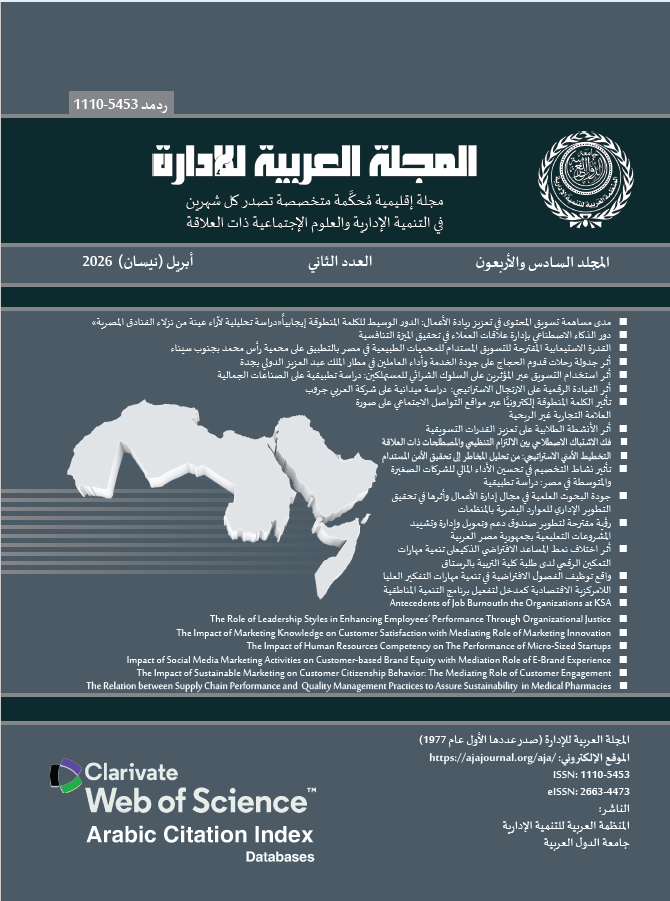
Antecedents of Job Burnout, In the Organizations at KSA

Article Sidebar
- Job Burnout, Job Satisfaction, Organization Learning Culture, Job Engagement
Abstract
This research aimed to study the factors that relate to job burnout in the organizations at KSA. There are 523 employees participating in this research from all sectors in Saudi Arabia. I used the electronic questionnaire to collect the data from the participants. Job satisfaction, job engagement, and organizational learning culture have a positive impact on the productivity of the employees in any organization, but on the other hand, job burnout will minimize productivity. The results of this research show that (1) there is a positive relationship between organizational learning culture and job engagement and (2) organizational learning culture is positively related to job satisfaction. Furthermore, (3), there is a positive relationship between job satisfaction and job engagement. On the other hand, (4) there is a negative relationship between job satisfaction and job burnout, (5) and also, job engagement and job burnout are negatively related to each other. These findings suggest that the job burnout of employees could be minimized through enhancing the learning culture in the organization, which will eventually lead to job engagement and job satisfaction.
Full text article
References
Akinola, A. A. (2020). “Influence of work engagement on job burnout among librarians in university libraries in nigeria”, Library Philosophy and Practice (e-journal), 4017.Artz, B.; Kaya, I. & Kaya, O. (2021). “Gender role perspectives and job burnout”, Review of Economics of the Household, 20 (2), 447-470. Https://doi.org/10.1007/s11150-021-09579-2Carmona-Halty, M. A.; Schaufeli, W. B. & Salanova, M. (2019). “The utrecht work engagement scale for students (uwes-9s): Factorial validity, reliability, and measurement invariance in a chilean sample of undergraduate university students”, Frontiers in Psychology, 10. Https://doi.org/10.3389/fpsyg.2019.01017Cetindamar, D.; Katic, M.; Burdon, S. & Gunsel, A. (2021). “The interplay among organisational learning culture, agility, growth, and big data capabilities”, Sustainability, 13 (23), 13024. Https://doi.org/10.3390/su132313024Coetzee, N.; Maree, D. & Smit, B. (2019). “The relationship between chronic fatigue syndrome, burnout, job satisfaction, social support and age among academics at a tertiary institution”, International Journal of Occupational Medicine and Environmental Health. Feb., 27; 32 (1): pp. 75-85. Https://doi.org/10.13075/ijomeh.1896.01274Fock, H.; Chiang, F.; Au, K. Y. & Hui, M. K. (2011). “The moderating effect of collectivistic orientation in psychological empowerment and job satisfaction relationship”, International Journal of Hospitality Management, 30 (2), 319-328. Https://doi.org/10.1016/j.ijhm.2010.08.002Kinicki, A. J.; Mckee-ryan, F. M.; Schriesheim, C. A. & Carson, K. P. (2002). “Assessing the construct validity of the job descriptive index: a review and meta-analysis”, Journal of Applied Psychology, 87 (1), 14-32. Https://doi.org/10.1037/0021-9010.87.1.14Kristensen, T. S.; Borritz, M.; Villadsen, E. & Christensen, K. B. (2005). “The copenhagen burnout inventory: A new tool for the assessment of burnout”, Work & Stress, An International Journal of Work, Health & Organisations, Vol. 19 (3), 192-207. Https://doi.org/10.1080/02678370500297720Lin, H. C. & Lee, Y. D. (2017). “A study of the influence of organizational learning on employees’ innovative behavior and work engagement by a cross-level examination”, Eurasia Journal of Mathematics, Science and Technology Education, 13(7). Https://doi.org/10.12973/eurasia.2017.00738aMohamed, S.; Nikmat, A.; Hashim, N. A.; Shuib, N. & Raduan, N. J. (2020). “Burnout and its relationship to psychological distress and job satisfaction among academician and non-academician in Malaysia”, International Journal of Higher Education, 10 (1), 85. Https://doi.org/10.5430/ijhe.v10n1p85Moradi, E.; Almutairi, D. O.; Idrus, D. & Emami, R. (2013). “The influence of organizational learning culture on job satisfaction among academic staff”, Journal of Global Management, 5 (1), 56-66.Park, K. A. & Johnson, K. R. (2019). “Job satisfaction, work engagement, and turnover intention of cte health science teachers”, International Journal for Research in Vocational Education and Training, 6 (3), 224-242. Https://doi.org/10.13152/ijrvet.6.3.2Pongton, P. & Suntrayuth, S. (2019). “Communication satisfaction, employee engagement, job satisfaction, and job performance in higher education institutions”, Abac Journal, 39 (3), 90-110.Saputra, N.; Abdinagoro, S. B. & Kuncoro, E. A. (2018). “The mediating role of learning agility on the relationship between work engagement and learning culture”, Pertanika Journal of Social Sciences and Humanities, 26, 117-130.Setiamargana, G. (2019). “The effect of organizational learning and work engagement on educators innovative behavior in sebasa polri”, International Journal of Advanced Research, 7 (8), 684-693. Https://doi.org/10.21474/ijar01/9549.
Authors
Copyright (c) 2026 The Arab Journal of Administration

This work is licensed under a Creative Commons Attribution-NonCommercial 4.0 International License.