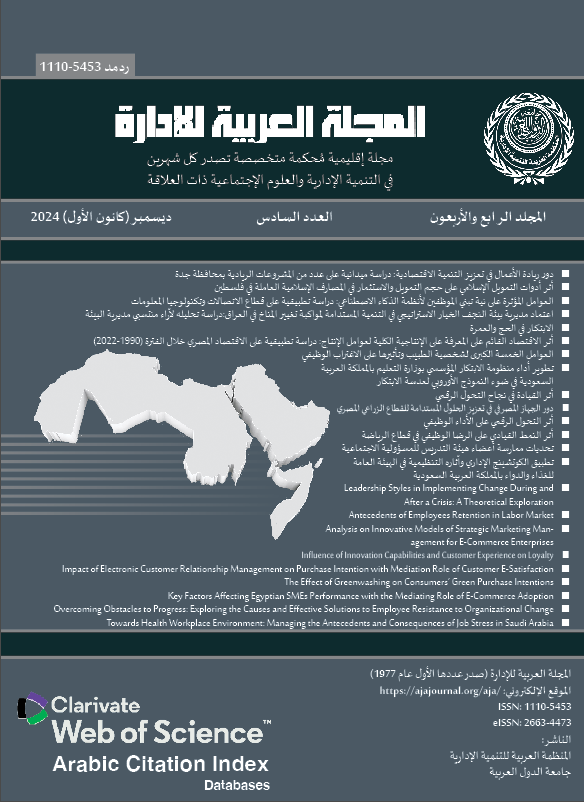
The Effect of Greenwashing on Consumers’ Green Purchase Intentions

Doaa Ayoub (1), Renad Awad (2)
(1) British University in Egypt, Egypt,
(2) British University in Egypt, Egypt

Abstract

Green marketing is widely used by brands all over the world using misleading ways to give brands an advantage to achieve their goals and sales. This is called greenwashing. The aim of the study is to examine the influence of greenwash on the purchase intentions among Egyptian consumers. It tested the mediation effect of brand love, brand loyalty, brand image, and green consumer confusion in the relationship between greenwash and purchase intentions and it also tested the mediation effect of green trust in the relationship between green brand image and purchase. The data were collected electronically from 386 participants using a structured questionnaire through social media platforms. The proposed model was empirically tested with the use of Structural Equation Modeling (SEM). The research concludes that greenwash practices adopted by companies in various industries should be stopped since customers should be informed properly about green aspects of the products offered by the brands. All hypotheses are accepted except the relationship between green confusion and green brand trust. This study provides novelty for the context of greenwashing, especially with the limited literature regarding the Arab context, specifically Egypt. Understanding how brand love, brand image, brand trust and green brand confusion influence consumer purchase intentions can help companies and marketers design and communicate specific messages to highlight their brand eco-friendliness in their marketing strategies. Hence, familiarity with their brand and the demand for and purchase of their brand’s eco-friendly products.

Full text article

Generated from XML file

Authors

Doaa Ayoub
Renad Awad
Author Biography

Doaa Ayoub, British University in Egypt

Dr. Doaa Ayoub is an assistant professor of Marketing at the British University in Egypt since 2014. She taught different Marketing courses in different business schools for undergraduate level at Faculty of Management Sciences, October University of Modern Sciences & Arts (MSA) and Faculty of Business Administration and International Trade, Misr International University( MIU) as well as graduate levels at the British University in Egypt (BUE) ,American University in Cairo (AUC )and ESLSCA. Since joining academia, she has researched on the subject of luxurious brand management, artificial intelligence, green marketing and digital marketing.
Dr. Ayoub had the honour to be selected to deliver a Global Marketing Research course at university of Economics in Katowice, Poland. She received Award for her outstanding performance in delivering lectures during the international week “Internet Communication Management “at university of Economics in Katowice in Poland.
Dr. Ayoub’s appointment as quality assurance officer of the Business Administration Department in the Faculty of Business Administration, Economics and Political Science at BUE and quality assurance officer for the MBA Programme. In 2019, she received also an appreciation award from the British University in Egypt for being awarded National Authority for Quality Assurance and Accreditation of Education (NAQAAE) accreditation for the faculty of BAEPS. Previously, she held many administrative positions in her department such as the staff development officer and library officer.
Dr. Ayoub has special interest in issues related to luxury marketing, digital marketing, marketing analytics, artificial intelligence, green marketing and database marketing.
Dr. Ayoub is a regular reviewer for marketing-specialised Journals (e.g. The Journal of Chinese Economic and Foreign Trade Studies) & Journal Humanities & Social Sciences Communications, published by Springer Nature. She has been involved in the training and consulting field for more than 15 years.

 
Ayoub, D., & Awad, R. (2024). The Effect of Greenwashing on Consumers’ Green Purchase Intentions. The Arab Journal of Administration, 44(6), 319–340. https://doi.org/10.21608/aja.2024.279587.1616

Article Details

Similar Articles

1 2 3 4 5 6 7 8 > >> 

You may also start an advanced similarity search for this article.

No Related Submission Found